PBR World Champions by Year: Winners and Multiple-Title Riders
Every individual PBR world champion from 1994 to 2026, with title totals, repeat winners, John Crimber's 2026 finish and the distinction from Finals event titles.
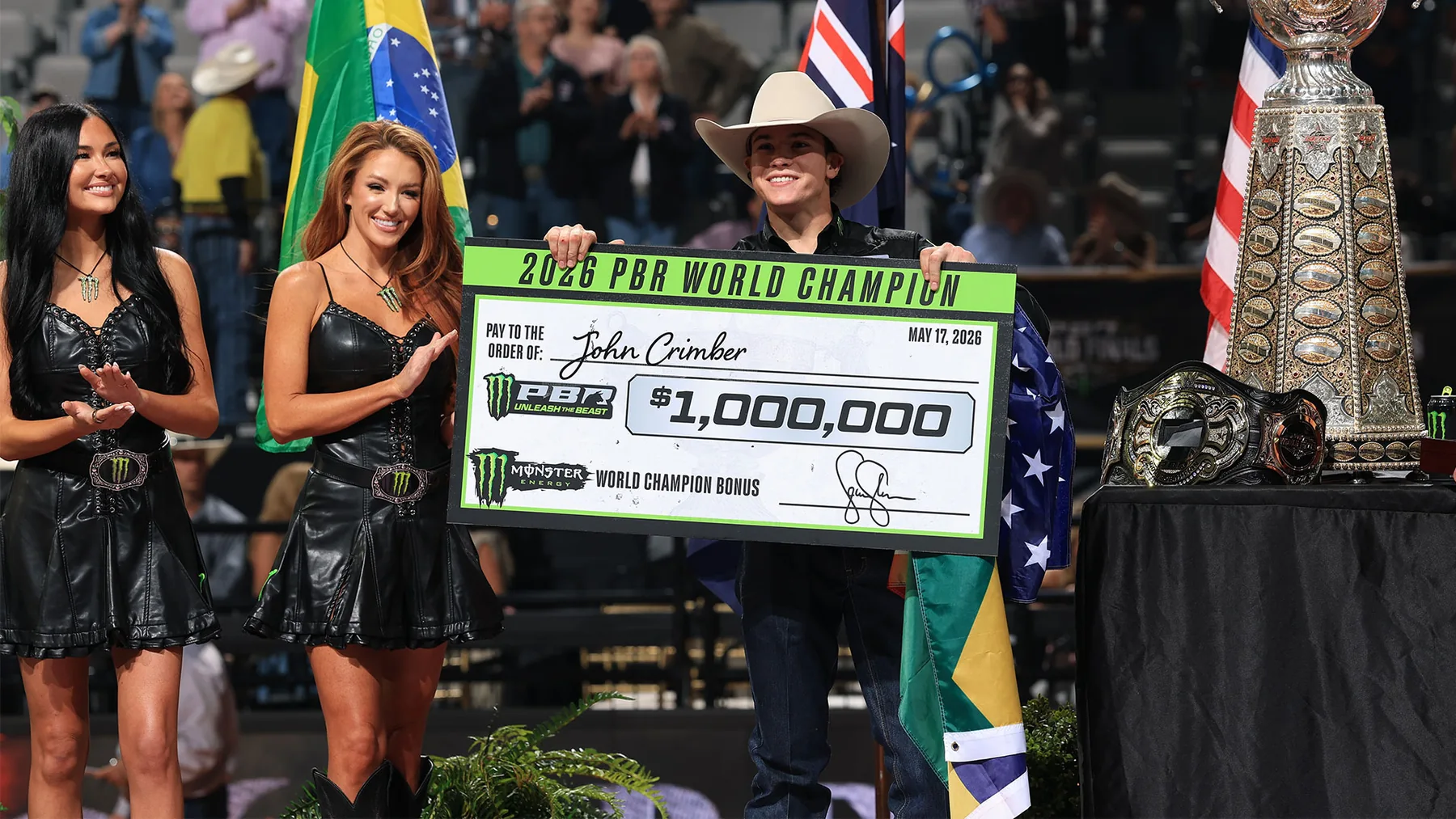
John Crimber is the 2026 PBR world champion, adding the latest completed season to a record that begins with Adriano Moraes in 1994. Through 2026, Moraes, Silvano Alves and Jose Vitor Leme share the most individual PBR world titles with three each. Seven riders have won more than once.
The complete year-by-year list below covers all 33 championship seasons from 1994 to 2026, followed by repeat winners and the context behind Crimber's first buckle. It records the premier individual season championship. World Finals event victories, PRCA bull-riding championships and PBR Teams titles are separate achievements, even when the same familiar names appear in those conversations.
What a PBR world championship means
This list records the premier individual PBR world championship, the title associated with the season culminating at the PBR World Finals. The first entry is Adriano Moraes in 1994. PBR's founding in 1992 is a different historical date; it does not create a 1992 or 1993 winner to insert before the official sequence. The title follows the competition's history through its different premier-tour names.
The season champion and the Finals event winner
A world champion and a World Finals event winner can be different riders. The season championship incorporates the relevant championship standings, while the event award recognises the Finals competition under that year's rules. A fan looking at the event aggregate alone can therefore identify the correct event winner and still give the wrong answer to “Who was world champion?” Read the award label before copying a name.
The 2012 season supplies a clear example. PBR's contemporary report identifies Silvano Alves as world champion and Robson Palermo as World Finals event winner. Palermo won that event in 2008, 2011 and 2012. Those three remarkable event victories do not make him a three-time winner of the season title listed here.
The distinction is not a judgement about which performance was exciting. Winning a Finals event against the sport's best riders and bulls is a major achievement in its own right. It simply answers a different question. When a broadcast says a rider is a “Finals champion,” listen for whether the speaker means the event buckle or the season's world championship.
PBR, PRCA and Teams titles belong in separate records
Professional bull riding also has more than one championship organisation. The PRCA's world bull-riding title belongs to its own rodeo season and championship system. In 2021, for example, Sage Kimzey was the PRCA bull-riding champion while Jose Vitor Leme was the PBR world champion. A rider can have an outstanding PRCA record without appearing as a PBR season-title winner.
PBR Teams adds another separate award context. A team championship recognises the winning team in that competition, and individual team-season honours have their own criteria. Wearing the colours of a successful team does not add an individual world title to a rider's career total. Conversely, a rider's earlier individual championship remains part of his record even when a team introduces him years later.
Use those distinctions when reading profiles and old results. “Champion” is meaningful only when it is attached to an organisation, competition and year. The official PBR world champions gallery provides the annual record used below. Other buckles can enrich a career discussion, but they should not be added to this particular title count.
Every PBR world champion from 1994 to 2026
The record below covers every completed championship season from 1994 through 2026. The three groups make a long list easier to scan; they are reading aids rather than official competitive divisions. Find the year first, then the rider. Repeated names indicate separate season titles, not duplicate entries for the same award.
1994–2006: the first champions and Moraes's three titles
| Season | PBR world champion |
|---|---|
| 1994 | Adriano Moraes |
| 1995 | Tuff Hedeman |
| 1996 | Owen Washburn |
| 1997 | Michael Gaffney |
| 1998 | Troy Dunn |
| 1999 | Cody Hart |
| 2000 | Chris Shivers |
| 2001 | Adriano Moraes |
| 2002 | Ednei Caminhas |
| 2003 | Chris Shivers |
| 2004 | Mike Lee |
| 2005 | Justin McBride |
| 2006 | Adriano Moraes |
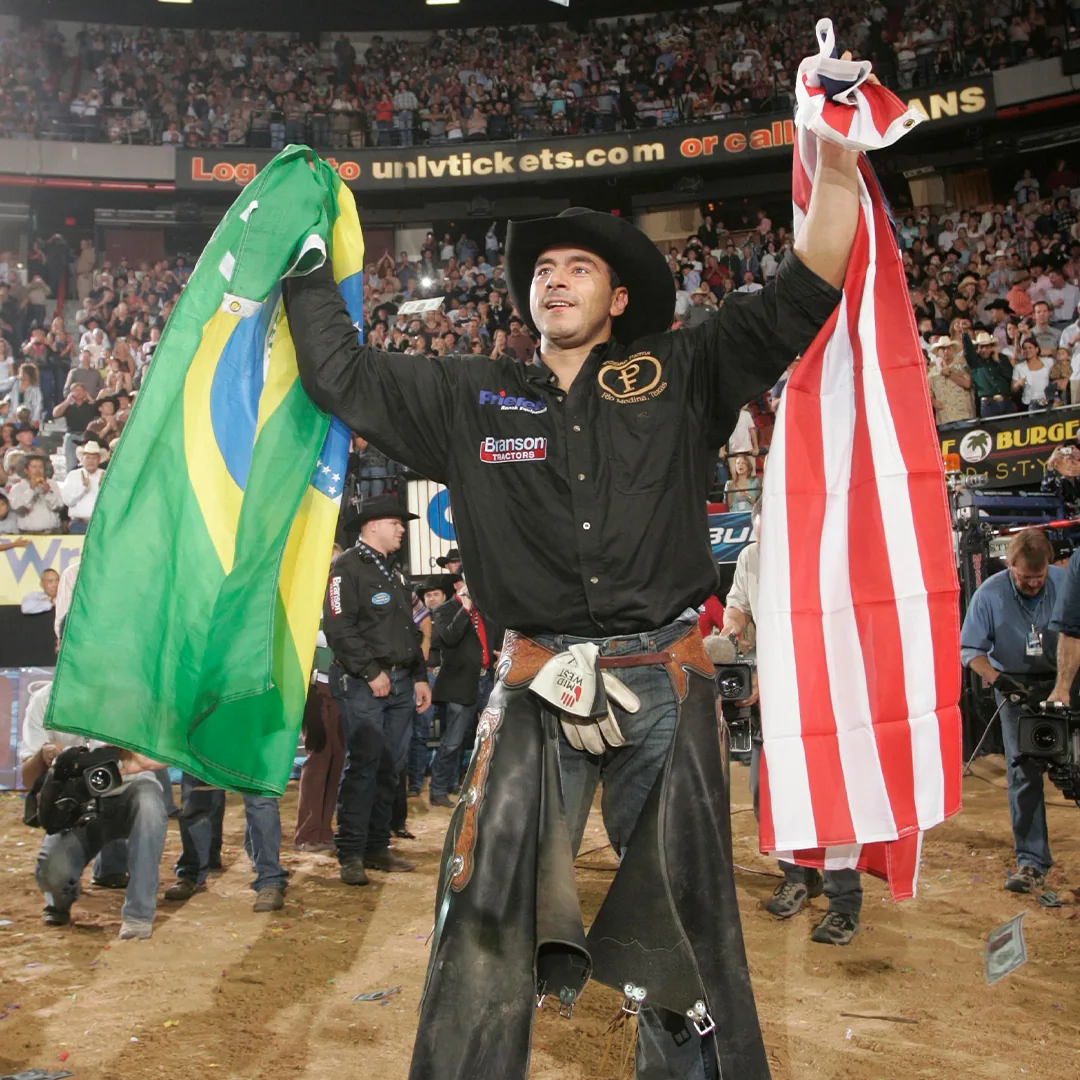
Moraes anchors this opening period: first champion, first rider to return for a second title and first to reach three. His championships were spread across 1994, 2001 and 2006. That spacing matters when describing his achievement. He did not win three consecutive seasons; he repeatedly returned to the top across a substantial portion of the organisation's early history.
2007–2019: repeat winners and new names
| Season | PBR world champion |
|---|---|
| 2007 | Justin McBride |
| 2008 | Guilherme Marchi |
| 2009 | Kody Lostroh |
| 2010 | Renato Nunes |
| 2011 | Silvano Alves |
| 2012 | Silvano Alves |
| 2013 | J.B. Mauney |
| 2014 | Silvano Alves |
| 2015 | J.B. Mauney |
| 2016 | Cooper Davis |
| 2017 | Jess Lockwood |
| 2018 | Kaique Pacheco |
| 2019 | Jess Lockwood |
McBride's second title opens this group, but the sequence soon moves through three different champions before Alves's run. From 2011 through 2015, Alves and Mauney account for every entry. That five-season pattern is visible without relying on a highlight package or an all-time ranking. It gives a new fan a useful starting point for exploring the rivalry and the competition surrounding those riders.
Lockwood's two titles surround Pacheco's 2018 championship. That is another reason to read the actual years rather than compressing a career into a single “two-time champion” introduction. The title count describes the achievement; the sequence shows how the championship changed hands.
2020–2026: Leme's third title and the latest champion
| Season | PBR world champion |
|---|---|
| 2020 | Jose Vitor Leme |
| 2021 | Jose Vitor Leme |
| 2022 | Daylon Swearingen |
| 2023 | Rafael Jose de Brito |
| 2024 | Cassio Dias |
| 2025 | Jose Vitor Leme |
| 2026 | John Crimber |
Leme's consecutive titles begin the period, followed by three new names before he returns in 2025. Crimber adds the 2026 entry. A list ending with Leme's third championship therefore misses the latest completed season. At the same time, a current standings leader should not be inserted into a future row: the historical record changes when the title has been decided, not when a contender looks likely to win it.
Across the full sequence, the simplest useful habit is to keep a rider's title years beside his name. It prevents a memorable Finals performance, a team success or a later career introduction from shifting a championship into the wrong season.
Riders with more than one PBR world title
Seven riders have won the individual PBR world championship more than once through the 2026 season. Three share the leading total of three titles, and four have won twice. Counting the annual record gives 33 championships won by 23 different riders. That is a calculation from the completed seasons, not a prediction about how any active rider's career will finish.
| Rider | Titles | Championship seasons |
|---|---|---|
| Adriano Moraes | 3 | 1994, 2001, 2006 |
| Silvano Alves | 3 | 2011, 2012, 2014 |
| Jose Vitor Leme | 3 | 2020, 2021, 2025 |
| Chris Shivers | 2 | 2000, 2003 |
| Justin McBride | 2 | 2005, 2007 |
| J.B. Mauney | 2 | 2013, 2015 |
| Jess Lockwood | 2 | 2017, 2019 |
Moraes, Alves and Leme share the three-title mark
Moraes established the three-title standard in 2006. Alves matched it in 2014, and Leme joined them in 2025. No rider has four of these titles through 2026. The three names belong together in a title-count answer even though their careers, styles and routes to the third buckle were different.
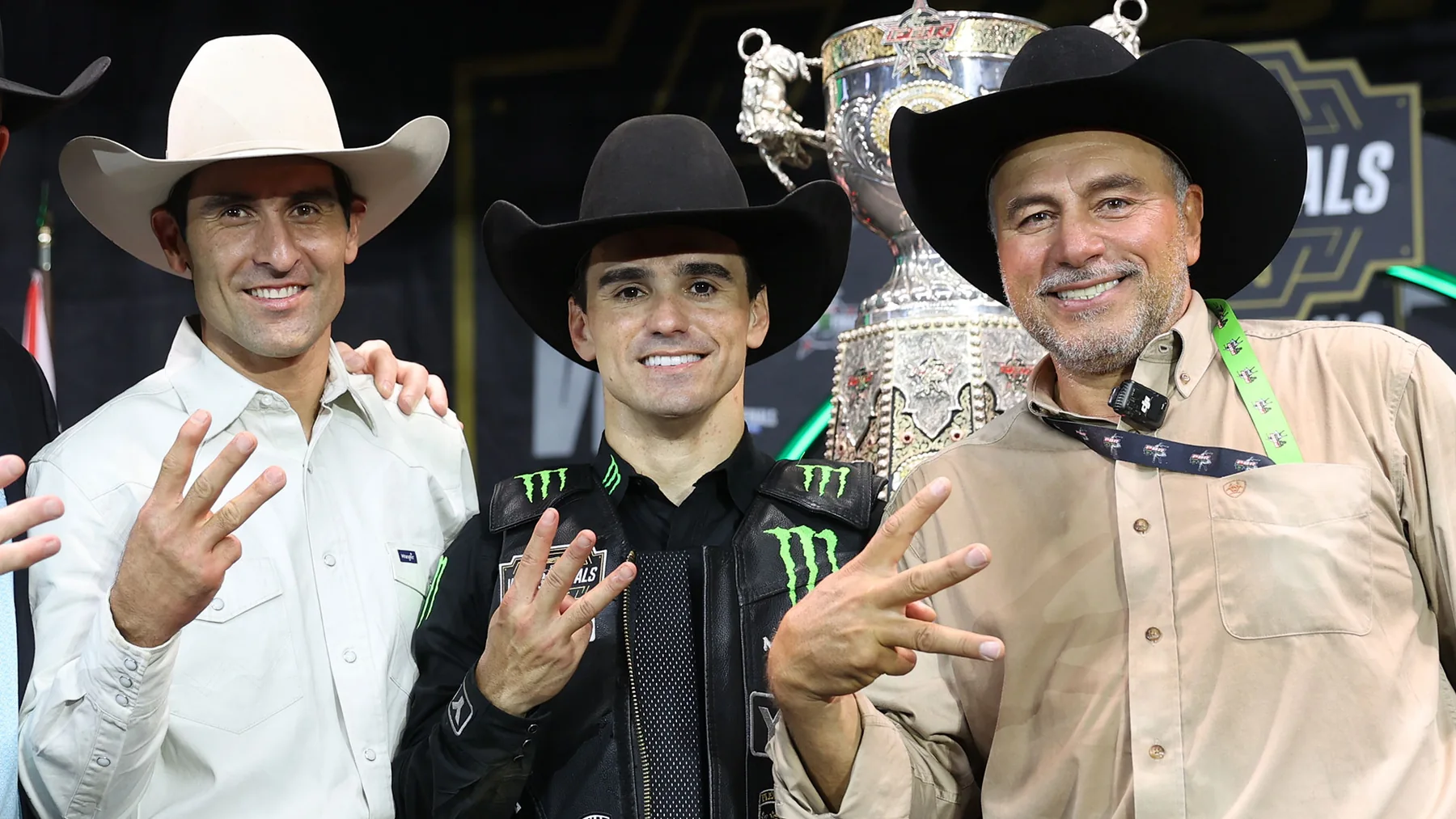
Leme's 2025 return is particularly useful for understanding why a career total should not replace a season story. PBR's account of that championship describes his rise from No. 18 entering the Finals to the title. Three buckles can therefore contain both sustained dominance and a dramatic late-season recovery. The final number is accurate, but it does not tell you which kind of campaign produced it.
Consecutive titles and titles won years apart
Alves became PBR's first back-to-back world champion by winning in 2011 and 2012. Leme later repeated that achievement in 2020 and 2021. The official annual sequence through 2026 contains no three-season championship streak. Alves's third title came in 2014, and Leme's third arrived in 2025, so neither three-title total should be described as three in succession.
There is a different kind of value in returning after other riders have taken the championship. It requires another successful campaign against a field that has continued developing. Moraes's long spacing between titles is an obvious illustration, while the two-time winners also show that a second championship need not immediately follow the first. That observation comes directly from the years, without needing an invented account of a rider's private motivation.
When discussing the record with other fans, specify the claim. “Most titles,” “first consecutive champion” and “long span between first and last championship” are different measures. The same rider does not need to lead every measure for his achievement to be significant. Keeping the measures separate makes the argument more informative and prevents an impressive but different statistic from being presented as another world title.
How John Crimber became the 2026 world champion
John Crimber won his first individual PBR world championship on May 17, 2026, at Dickies Arena in Fort Worth. He was 20 at the time. That result belongs in a completed historical record rather than a list of promising young contenders. His career may produce more chapters, but the 2026 buckle is already an established achievement.
The route to it was far less straightforward than a two-line champion introduction suggests. Crimber began the World Finals without a qualified ride on his first five attempts. He then completed four in succession, finishing with two round-winning rides on Championship Sunday. The opening failures and late recovery are both necessary to understand the event; showing only the last celebration removes the competitive problem he had to solve.
PBR's championship feature records the recovery beginning with 89.40 points aboard July in Round 6, followed by 84.95 on Icky Thump in Round 7. Crimber kept that second score rather than taking an offered re-ride. That decision illustrates a real competitive tension: a chance at a better mark also means accepting another attempt instead of banking a completed ride.
On Sunday, he won Round 8 with 91.35 points on What's Poppin, then scored 92.90 on Tigger in the Championship Round. PBR's official Tigger highlight preserves that final ride. The numbers matter because they show the scale of the finish, but the sequence matters as much: Crimber needed to keep producing qualified rides as the championship reached its last opportunities.
He finished sixth in the World Finals event aggregate while winning the world championship. Hudson Bolton, who went 7-for-9, won the Finals event title. That current example reinforces the difference introduced earlier: the winner of the season's world championship need not top the final event's aggregate. Brady Fielder finished second in the world standings, giving the title race a different order again from the event leaderboard.
For a fan comparing generations, Crimber's first title is an invitation to watch how a championship is constructed, not a reason to declare the rest of his career settled. The 2026 rider guide supplies broader context around the field, while published results help separate the season outcome from a memorable individual ride. The historical table records the winner; the performance sequence explains why that entry is worth remembering.
How to compare champions across different eras
The annual list answers who won. It cannot, by itself, settle every argument about who rode best. A world title is a powerful career achievement, but a comparison can also ask about peak scoring, repeated qualified rides, longevity or the difficulty of particular matchups. State the question before selecting the statistic. Otherwise, the criteria tend to change whenever a favourite rider needs help.
Leme's 2021 season offers one concrete measure of scoring excellence: PBR's season review records 24 rides of 90 points or more and his 98.75-point ride on Woopaa. Those figures help explain the character of that championship. They add detail that the single entry “2021 — Jose Vitor Leme” cannot carry.
Alves's 2014 Finals offers another kind of evidence. He went 6-for-6 while earning his third world title and the event title. Repeated completion across an entire Finals is a different way to describe excellence from highlighting the biggest individual score. Both deserve attention because bull riding rewards making the whistle as well as converting a difficult bull into an exceptional mark.
Use title totals as a starting point for the argument
For a fair comparison, look at attempts alongside qualified rides and make sure the records cover the same competition. A percentage without its number of attempts can flatter a short run. A career total without the years or opportunities behind it can obscure a concentrated peak. Team appearances, premier individual events and other tours should not be mixed casually into one supposedly comparable statistic.
Be equally careful with money and championship points. Purses and points systems change, so a larger raw figure from a later season does not automatically prove a greater performance than an earlier champion's total. Compare a rider with the field and rules he actually faced. The title itself remains the award he won; the surrounding numbers explain how he won it.
The greatest PBR riders guide takes up that broader career discussion. This reference keeps the narrower championship question clear: Moraes, Alves and Leme share the three-title lead through 2026, seven riders have multiple titles, and John Crimber holds the latest completed season's individual world championship.
History becomes more rewarding when it changes what you notice during the next competition. Watch how a contender deals with a missed ride, how he chooses between banking a score and taking a re-ride, and whether he keeps producing when the final-round pressure rises. The event calendar and viewing schedule connect those historical questions to the next set of riders trying to add their own year to the record.
Keep reading
Related PBR articles
Riders & Bulls
PBR Australia 2026 Title Race: Shephard, Hall and the Run to Townsville
By PBR Schedule Editorial TeamRiders & Bulls
Jean Carlos Teodoro's 2026 PBR Teams Rookie Award: What He Won and Why It Matters
By PBR Schedule Editorial TeamRiders & Bulls
Join the conversation
Comments
Comments are reviewed before publication. Keep the discussion useful, respectful and focused on bull riding.
Sign in with Google to comment
Your public comment shows your account name. Your email address is not displayed.
Commenting as
Loading comments…